System Overview
Goals for this Tutorial
The purpose of this tutorial is to provide a practical overview of how the Canon EX flash system works and how it impacts purchasing decisions. The ideal time to be reading it is before buying your first Canon flash because as you will see if it isn't a 580ex you will be limiting the potential of your overall system.
This overview deals with the Canon system from the standpoint of how Canon intends it to be used. For example there is no standard PC plug on a Canon flash because Canon designed it as a wireless system an expects you to use it that way. That also answers one of the most commonly asked questions: why the TTL extension cord is only two-feet long. Because its only function in Canon's view is to move a MASTER flash up onto a flash bracket.
I happen to agree with Canon's philosophy. I've used dual flash for since 1972 with every imaginable combination of wired and optical triggering, diffuser and umbrella. The reasons I bought a pair of Canon 580ex was to finally cut the cords and to take full advantage of the sophisticated metering in the camera. I am however aware of all the workarounds to what some see as the limitation of the Canon system, but I deal with them in a separate document.
At the time this was originally written the Canon EX wireless control flash system consisted of the 580ex, 430ex, 550ex, 420ex and the ST-E2 non-flashing controller. Since then newer mkII models have been introduced to replace the 580ex and 430ex and Canon has copied Nikon's approach of allowing the built-in camera flash to act as Master.
The 580exII is functionally the same as the 580exII in terms of its power and how slaves are controlled. It added other new features such as thermal protection, an "auto" mode (exposure sensor in the the flash) a designed metal foot and a rubber weather seal. The redesign also eliminated a very useful feature of the 580ex; the switch on the base that allowed switching back and forth from single and multiple flash use. Switching modes on the 580exII requires navigating through the option menu. Concurrent with the introduction of the 580exII Canon added the ability to control the flashes to the menu of its newer camera bodies. Unfortunately these new features have caused a problem. The weather seal on some 580exII flashes causes the flash to loose contact with the camera and the loss of contact makes the flash think its been told to switch in the TTL mode. TTL mode is a legacy mode for film bodies which meter exposure off the film during the exposure. On a digital camera the flash set to TTL fires at full power because it never gets a signal to end the exposure. Canon has never officially acknowledged this defect. My recommendation to anyone considering a flash to use as a Master in a dual flash system is to try to find a used 580ex as the Master flash and use the newer 580exII as the slave. The random TTL switching problem does not occur when the 580exII is used as a slave
Cameras introduced in 2009 such as the 7D added the ability of the in-camera flash to act as Master and control slave flashes. That might seem like a really good thing, but repeats the mistake Canon made with the ST-E2: basing the control of the wireless system around an under-powered flash with a limited range and signaling footprint. The built-in flash used as a controller does not have enough power to act as fill. All things considered I think a 580ex flash on a bracket over the camera is still the best option as Master and fill in a two light configuration used for photojournalist style shooting, on the move without being tied down with large modifiers.
Commonly used accessories for the system include the two-foot long hot shoe extension TTL cable which facilitate mounting the master flash on a bracket and the CP-E4 high voltage external battery pack which cuts recycle times in half. But anyone considering the CP-E4 should realize that the Canon flashes are not designed for continuous use like a studio flash unit. The older 580ex model can be driven to the point of failure and melting with sustained use with an external battery. The newer 580exII added a thermal cut-off that stops the flash from firing, without any prior warning. The SB-E1 bracket is shown in flash manuals in the system diagram but it is not marketed in the United States.
All of the EX flashes can be used individually or as part of a multi-flash wirelessly controlled network of flashes. In multiple flash configurations the unit connected to the camera hot shoe directly or with the hotshoe extension cord 2 becomes the MASTER controller. Off camera flashes operate as SLAVE. Any of the flashes listed above except the 380ex can function as a SLAVE, but only the 580ex, 550ex and ST-E2 controller can act as MASTER. It is also important to note the 420ex lacks a manual power "M" mode; it can only be used individually or as a SLAVE in TTL mode.
In multiple flash configurations each flash unit must be assigned to one of three groups which are designated as A, B and C. A 580ex/550ex MASTER flash or ST-E2 controller connected to the hot shoe is always assigned by default to Group A. SLAVE flash units may be assigned to Group A, B or C. A 580ex/550ex MASTER flash can control all three groups in both "TTL" and "M" (manual) modes. The ST-E2 controller is limited to wirelessly controlling two SLAVE groups A and B in "TTL" mode. The ST-E2 controller can also be used fire 580ex/430ex/550ex SLAVES set to "M" mode but not set power remotely; the power level for each SLAVE must be set on the flash.
Groups A and B:
In the Canon system the A and B groups are considered to be the "key" and "fill" lights but the instruction in the flash manuals are not clear regarding which role each group should play in the lighting scheme. For example, the 580ex manual shows the configuration below as an example of a "two" flash A:B configuration.
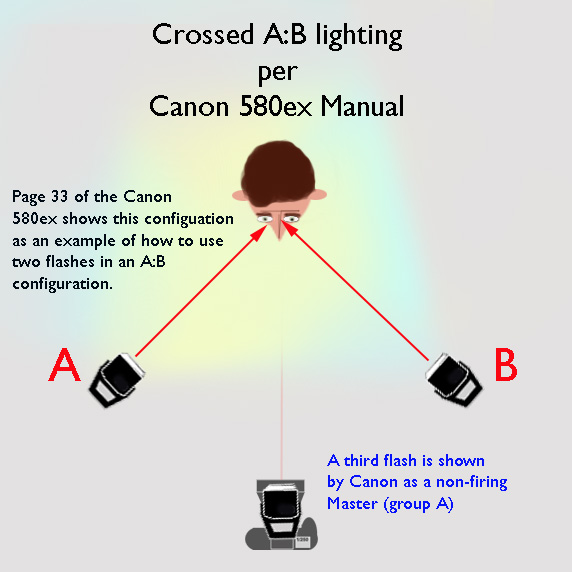
Readers with experience in studio lighting should recognize that configuration as what is known as "crossed-shadow" lighting which is very unflattering for portraits. In a crossed configuration like that it is impossible to tell whether the A is key or and B is fill, or the other way around. That and the fact Canon shows a third unit on the camera as MASTER seem to really confuse people and convince them they must have an ST-E2 to use wireless ratios.
One of the hallmarks of experience is having tried many things and learning from that experience what is most practical. My first camera in 1969 was a Nikonos II underwater camera which had no exposure meter or focusing aidsI was taught and mastered the use two hot shoe style flashes together at wedding receptions by renowned photographer and teacher Monte Zucker, who I assisted full-time. Over the years I have tried many other ways to use a pair of hot shoe flashes, but I have not yet found one which is more effective:
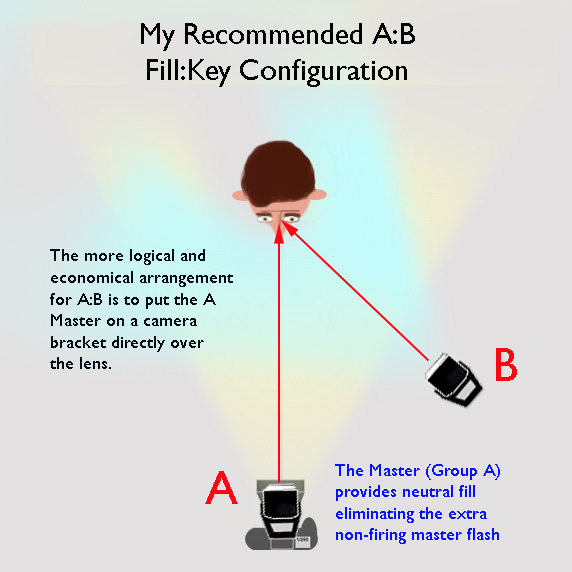
In the configuration above the MASTER A flash is placed on a camera-flip flash bracket and connected to the camera using the hot shoe extension cord 2. The off camera flash is set to SLAVE and Group B. I place mine on a modified medical IV stand which has a compact but very stable 5-leg base and wheels. The "A" flash becomes neutral fill which illuminates the entire scene uniformly (no crossed shadows!) and the "B" flash becomes the key light which can be positioned precisely to create any desired lighting pattern.
When is a ST-E2 Needed?
Many people on a budget start with the less expensive 430ex which can only be used as a SLAVE. They quickly discover both the modeling limitations of a single flash mounted in the hot-shoe and that their 430ex is actually part of a very neat wireless system. At that point they have two choices. They can either spend about $400 to purchase a 580ex to serve as MASTER for their 430ex, or opt for the $200 ST-E2 controller. Others seeing the illustrations in the flash manual or studio lighting sets using two umbrella may purchase an ST-E2 as the MASTER an two 430ex for use with umbrellas on stand as A:B group SLAVES.
The first approach of using a single SLAVE with an ST-E2 is flawed because there is no fill! When a single flash is moved off axis it will create dark shadows devoid of detail. A reflector can be used with a single flash to supply the fill, but without a modeling light on the flash to guide its placement controlling the shadows is a tedious trail and error process.
The second approach of using two SLAVE flashes on stands with umbrellas with a ST-E2 MASTER to control them is very inconvenient and costly when compared to the two flash bracket and stand approach. The umbrellas are what make this approach impractical in my view, a view formed by actually using two umbrellas with hot shoe flash for several years before concluding that the umbrellas really defeated the purpose of owning a portable flash system. Also I found that umbrellas made it difficult to control the light because the light was too diffuse.
Some of you may have read that last sentence and are a bit confused because you've never heard anyone say light can be too diffuse. I presume you are still reading because you think I know what the heck I'm talking about, so let me explain what I mean by that statement.
Remember when I said I started with flash by mastering the use of two flashes to shoot wedding receptions? They were direct, unmodified flashes and I shot dozens of wedding receptions where nearly every photo including dance floor shots were taken with two direct flashes. I was taught by one of the best classical lighting practitioners on the planet, Monte Zucker and from him I learned that precise placement of the key light to create flattering lighting pattern combined with neutral even fill to open the shadows which created lighting which was eye catching and dramatic, but with buttery smooth highlight/shadow transitions. Even with direct flash!
The secret is the neutral fill. Consider that if fill overpowers the key light it is virtually the same as using a single flash; there is no modeling. But when the fill is backed off so it is the same strength as the key light there is a magic combination of modeling and soft shadows. Don't just trust me about this, try it and see for yourself with a pair of direct flashes using the bracket / stand approach I illustrated above.
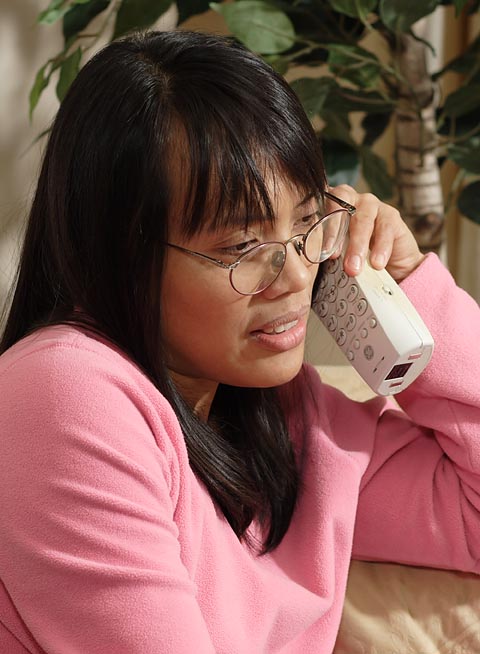
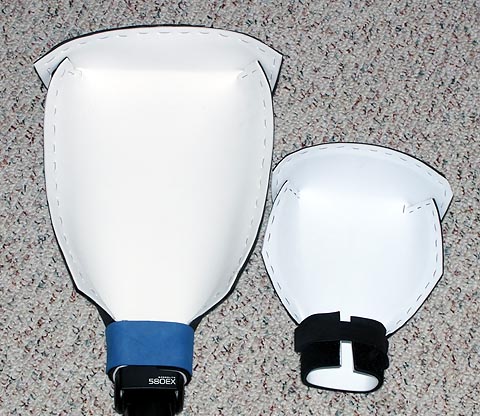
So my answer to the question "When is a ST-E2 Needed" is never, at least in my needs. I have found that the basic configuration I learned from Monte 35 years ago is still the most practical balance of lighting quality and convenience. That shot above wasn't posed, I just rolled my off camera flash into place about 45 degrees right of center from her nose, dialed in the desired ratio and fired. She was barely aware of what I was doing or that I was using a second flash. The lighting looks natural soft and flattering because the shadows models the face naturally and fill is even. Did I use umbrella to soften the light? Nope. Just a couple of 9 x 12 sheets of foam folded over to form a round bowl-shaped reflector on top of the flash:
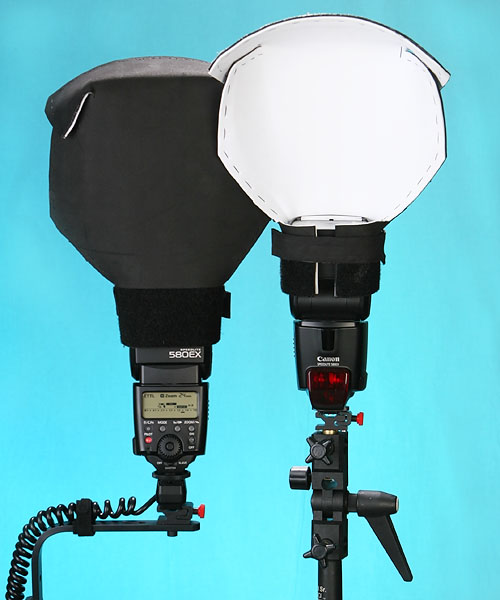
Some may prefer the softer look an umbrella provides, but that does not automatically mean two stands and two umbrellas are needed. Look closely at the flash on the right in the photo above. What is holding it on the "Pitch It Sr." IV stand I use? Yes Virginia, that is a $20 universal umbrella bracket! So with the bracket / single stand approach I advocate it is possible to still use the MASTER "A" flash on a bracket, and use either the diffuser or an umbrella for the off camera light. If you like the convenience of the foam diffuser but want the light to create softer shadows just make one out of a larger sheets of foam. The one on the left is make from 12 x 18 inch sheets, the one one the right 9 x 12 inch sheets.
What is the best thing about the bracket / foam diffuser configuration? My "studio" with the exception of the folding stand fits in the Canon 1G bag below, with the flash bracket clipped to the top handle and the foam diffusers placed on top of the camera and lenses to help pad them:
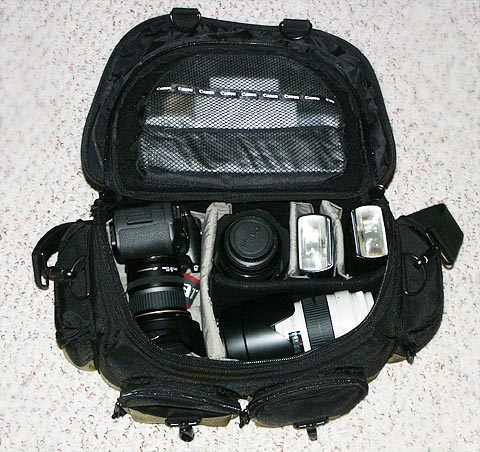
Like I said, when you do this stuff for as long as I have you find the easiest way. Note I didn't say the best possible way. In all things there are compromises and a "best" tool for each task. I also have a four studio flash heads and a variety of modifiers (see equipment section for details) for when they are the best tool.
The Hot Shoe vs Studio Flash Dilemma
This is a good place to address one of the first questions a beginner with a single Canon flash typically asks, "Should I buy another Canon flash, or Alien Bees?"
There are a few things to consider when making the choice. First, if you get serious about lighting you will eventually decide you need both. If you decide to forego the second Canon flash to get a studio flash or two instead, when you learn how to create decent looking lighting you will be so disappointed with the flat look of shots with the flash in your hot shoe that you will want a second to do studio style lighting anywhere. But if you do get that second Canon flash you may find you want to go further with lighting than a two- or three-speedlight system can take you. For example it is very difficult to do full body shots on white backgrounds with hot shoe flash. It's not impossible mind you, but its not easy either.
Cost-wise a pair of Canon flashes and a pair of AB800s and accessories are similar within a hundred bucks or so. But be warned. Getting a pair of Canon flashes is like buying a canoe; you got the boat and paddle, not much else you need. Wherever you go your studio travels with you; work, vacation, grandma's house, out in the yard. Buying your first studio flash is like buying a used sailboat; it seems there is always something else you need or want and before you know it you've got three grand worth of lights in the basement and a wife and kids who run and hide when you turn them on... So the first thing to do is realistically evaluate what your needs and goals are, which you will use / need the most, and how much you can afford to spend over the next couple years.
Some will justify getting studio lights because the modeling lights made learning lighting easier. I will tell you from my experience that a window is actually a far better learning environment. Again that comes from experience. When I worked for Monte he did all his formal portraits by a north-facing widow with a reflector and a background painted on an eight-foot roll-up window shade. It costs nothing, you already have it and reduces the learning environment two to variables: 1) pose the face to the most flattering light, 2) move the camera to find the most flattering facial angle. Buy a set of four lights for your basement and try to use them all at once and you move them around for five years before you begin to see those simple cause and relationships.
There is a simple trick to placing the key light without a modeling light. Just stand in front of it so you see what the light does. What you see will be where the highlights are. What you don't see will be in the shadows. You literally see the light! The neutral fill on the camera bracket takes care of the shadows. Combine a few hours with a window learning to recognize how to turn a face into the light to get a flattering "short" lighting pattern with the trick of "seeing the light" and you will be forever liberated from the crutch of modeling lights. I used a window and a pair of hot shoe flashes for 30+ years before I bought my first studio lights. Even then I bought them more out of curiosity and to understand how they worked vs window and hot shoe flash so I could make this type of comparison.
A Growth Path for a Canon System
For those who don't yet have a flash and want to buy one which will fulfill your current needs but still leave all options open I recommend purchasing the following equipment:
- Canon 580ex or used 550ex
- Canon hot shoe extension cord 2
- Strobframe camera-flip bracket (or similar bracket)
- DIY reflection-diffuser (make it yourself)
Why a 580ex or 550ex and not a 430ex? Key/Fill lighting ratios require that the off camera key light be at least as strong as the fill light. If you plan to use a two light system and want to avoid the limitations of the ST-E2 mentioned above (and expanded on below) the only choice for the MASTER is the 580ex or a used 550ex. The 430ex has guide number of 141 vs 190 for the 580ex. That is nearly a full f/stop difference (f/14 vs f/19 @ 10ft @ ISO 100). Simply put when a 430ex is used as a SLAVE it may wind up working twice as hard relative to its maximum capability at the lowest 1:1 A:B ratio than the 580ex MASTER and when a 1:8 A:B ratio is used the 430ex will be "pedal to the medal" while the 580ex is barely above idle.
A 580ex / 430ex MASTER / SLAVE combination will work fine, but its over range will be limited by the lower power of the 430ex, especially when higher ratios and diffusers, umbrellas or bounce which cut output by about three f/stop. The recycle times for a 580ex/430ex combination will be longer than for a pair of 580ex because the 430ex will be draining its capacitors more with each shot. The CP-E3 external battery pack which holds eight AA batteries can be used to cut the recycle time in half but there is a catch; only the 580ex and 550ex can use it. So the bottom line in my view is that buying 430ex limits the potential of the overall system and buying it first paints us into corner.So your first choice should be a 580ex or used 550ex if you can't afford the extra $200.
What can be done with a single flash on a bracket?
Actually a single flash on a bracket with a diffuser is the best light which can be produced with one flash. Forty years ago when wedding photographers used harsh direct flash they discovered raising it about a foot directly above the lens hid the nasty distracting head shadow down behind the shoulder line. The nose shadow falls down directly under the nose where it isn't noticed and the shadows under the cheeks actually flattered the face more. When the foam diffuser is added the shadows are even less noticeable and more flattering.
What to get for a second flash?
If the initial purchase was a 430ex and answer is simple; a 580ex or used 550ex to serve as master. If a 550ex or 580ex was purchased first my first choice would be the 580ex, my second the 430ex, and my last the 550ex. I would not even consider a 420ex because it lacks manual mode. Why a 430ex before a 550ex? Simple, better resale value when you decide I was right after all and sell it on eBay to buy a 580ex
Do we really need a third flash?
First understand how the third group in the Canon system works differently than A:B. With the exception of the 420ex the Canon flashes can operate in "TTL" mode (i.e. TTL/E-TTL/E-TTL-II depending on camera type) or M manual. The MASTER is always Group A by default, and when it is set to TTL mode with a SLAVE flash set to Group B the photographer simply dials in the desired ratio on the back of the master to set the A:B ratio then adjusts flash exposure compensation (FEC) to adjust the exposure of the highlights. The operation in M mode (on the flash) is similar, but instead of dialing in the A;B ratio the actual power levels of A and B are set from 1/1 to 1/128 (580ex) or 1/64 (430ex) using the buttons and wheel on the MASTER.
In TTL mode the Canon system meters the A:B ratio with a series of pre-flashes: A then B, then A and B together to adjust the ratio and exposure of the main foreground subject. In M mode there are still pre-flashes to instruct the slaves, but since power is set manually there are no pre-flashes for ratios or exposure. Note: the pre-flashes prevent the use of a hand held meter in M mode.
Group C is Different than A and B
Canon states in its manuals that a flash set to Group C should be aimed at the background and never hit the subject in the foreground directly. The reason for this is not explained in the manuals and is related to the pre-flash and metering sequence. The overall output of the flashes in A:B C TTL mode is determined by the A:B pre-flash sequence described above. Once that is determined the C group flash is pre-flashed and evaluated then instructed to set its output to match A:B. The photographer must take a test shot to evaluate the balance of the C group illuminating the background with the foreground. If needed the photographer can adjust the level of the C group remotely from the MASTER by selecting C and then entering a Flash Exposure Compensation. Thus A;B is adjusted via ratio, and C is adjusted manually to it (if necessary) via a special form of FEC. It all sounds a bit complicated, but in practice it is quite simple. See the multiple flash tutorial for an example of A:B C showing what each flash contributes.
The 580ex as a "Silent" MASTER
I don't consider hot shoe flashes to be an appropriate tool for serious studio portraiture because the range of modifiers they can use is very limited. That is why I finally decided after 30 years of hot shoe and window use to buy set of studio lights. For everything else such as shooting candid location portraits, editorial or other types of location shots where a simple, portable and convenient lighting solution is important I find dual Canon 580ex flashes do the job quite well.
Because I keep my Master flash on a bracket I never find the need to use two Canon flashes on separate stands triggered by a non-firing MASTER. But as they say, "Your mileage may vary." and you may prefer the two-stand A:B approach and will be faced with two choices as MASTER: ST-E2 or 580ex?
The ideal situation in Canonland is to have three 580ex flashes. Then two flash A:B, three flash A:B C, or a non-firing MASTER three flash A:B configurations are possible. Since all units are equal power none of the configurations will be limited by a weaker flash, and if one of the units breaks the remaining two are fully interchangeable.
Starting with a 430ex and then getting an ST-E2 on the the assumption moving the 430ex off camera will improve the lighting is naive in my view and why I'm writing this overview. With that combination the user will soon recognize the pitfalls of not having a source of fill and want to buy another flash. Already have a MASTER in the ST-E2 and going that route in the first place to save money many will opt for another 430ex instead of 580ex.
Cost? Do the Math
The ST-E2 costs $210 and and a 430ex $240, so a dual-430ex with ST-E2 MASTER winds up costing $690. A 580ex is $380 so a pair of them will cost $760 or only $80 more. Both will perform the same task of A:B TTL or M mode flash, but as they say in the infomercials, we're not done. Let's say we decide we want that third flash to control the background. With the ST-E2 we've already hit the end of growth path because it can only control two groups. If we started with the 580ex then added a second 580ex or 430ex we could add a third 580ex or 430ex and have the ability to do everything the Canon system is capable of doing: A:B TTL ratios, A:B TTL ratios + C background, A:B with a non-firing MASTER, and A:B or A:B C manual power; all controlled wirelessly from the MASTER. Total cost for the 3x 580ex system? $1,140 Lighting possibilites? Priceless.
Summary
In this tutorial we've walked down a typical growth path explaining along the way how Canon designed the system to work and how that impacts long-term purchasing decisions. I studied the Canon flash system for several months before I decided to buy one. I even asked others to do ratio tests so I could. I bought a pair of 580ex for the reasons I've explained above. If I were to buy a third Canon flash it would also be a 580ex because even though it costs $140 more than a 430ex it has much greater value in terms of performance and redundancy. I never even considered buying an ST-E2 and do not recommend it. It looks like a low cost option to move a single flash off camera, but you are better off with two flashes in the role of fill and key so pattern and ratio can be controlled. If you initially buy a 430ex and ST-E2 and find you want a second flash you will wind up paying more for a two-light solution and not be able to control manual power.
Holistic Concepts for Lighting
and Digital Photography
This tutorial is copyrighted by © Charles E. Gardner. It may be reproduced for personal use, and referenced by link, but please to not copy and post it to your site.
You can contact me at: Chuck Gardner
For other tutorials see the Tutorial Table of Contents